


.png)
Talk to the experts
Learn more about Extend and find out if it's the right solution for your business.
September 1, 2026 4:07 PM

Every finance team knows the feeling. Someone spots a charge that doesn't look right. You pull the statement. The transaction is three weeks old, the vendor is unfamiliar, and now you're working backward through approvals trying to figure out whether someone authorized this or not. By the time you have an answer, the money is gone, the month is closed, and you're filing a dispute that may or may not be resolved in your favor.
This is how most businesses experience payment fraud. Not through real-time alerts, not through automatic blocks, but through retrospective discovery. And as payment volumes grow and spend gets distributed across more people and more vendors, the problem does not get smaller on its own.
The good news is that most business payment fraud is preventable. Not at the detection layer, not through better forensics, but at the authorization layer. With the right card infrastructure, the majority of fraudulent transactions simply can't happen in the first place.
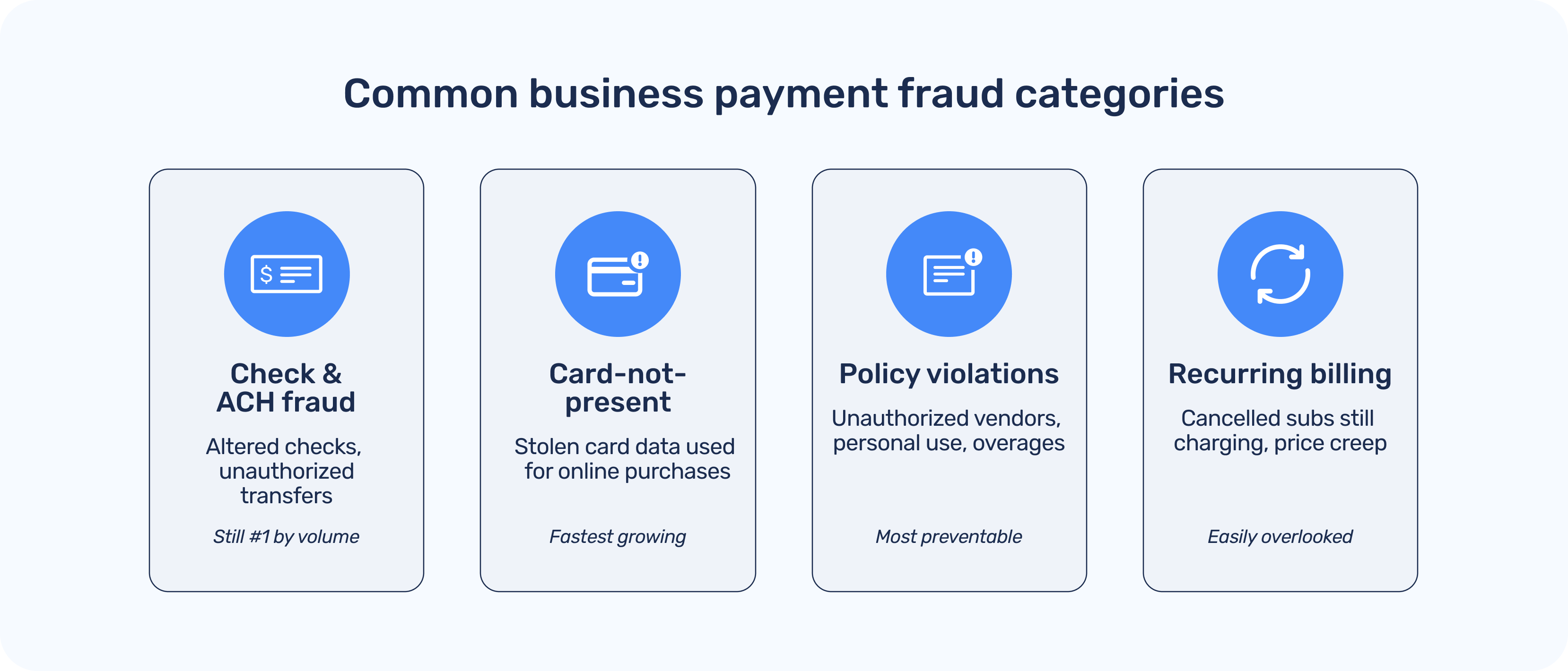
The Association for Financial Professionals surveys finance executives annually on fraud attempts, and year after year, the results show that the majority of organizations have been targeted. Check fraud remains the most common vector, but card fraud, ACH fraud, and wire fraud are all growing as transaction volumes shift online and spending becomes more distributed across teams.
Several dynamics are making the problem worse. Remote and hybrid work has expanded the number of people who need access to corporate payment methods. Software subscription sprawl means more vendors, more recurring charges, and more opportunities for unauthorized or simply forgotten billing. And as companies scale, the informal trust networks that once made manual oversight practical no longer cover the full span of who is spending what.
Finance teams are also contending with a subtler category of loss: not outright fraud, but unauthorized or policy-violating spend that falls through the gaps of a reactive review process. This can look like an employee using a corporate card for a personal expense, a vendor charging a renewal that was supposed to be cancelled, or a contractor's one-time payment card getting used a second time. None of these are necessarily malicious, but they all represent money leaving the business outside of authorized channels.
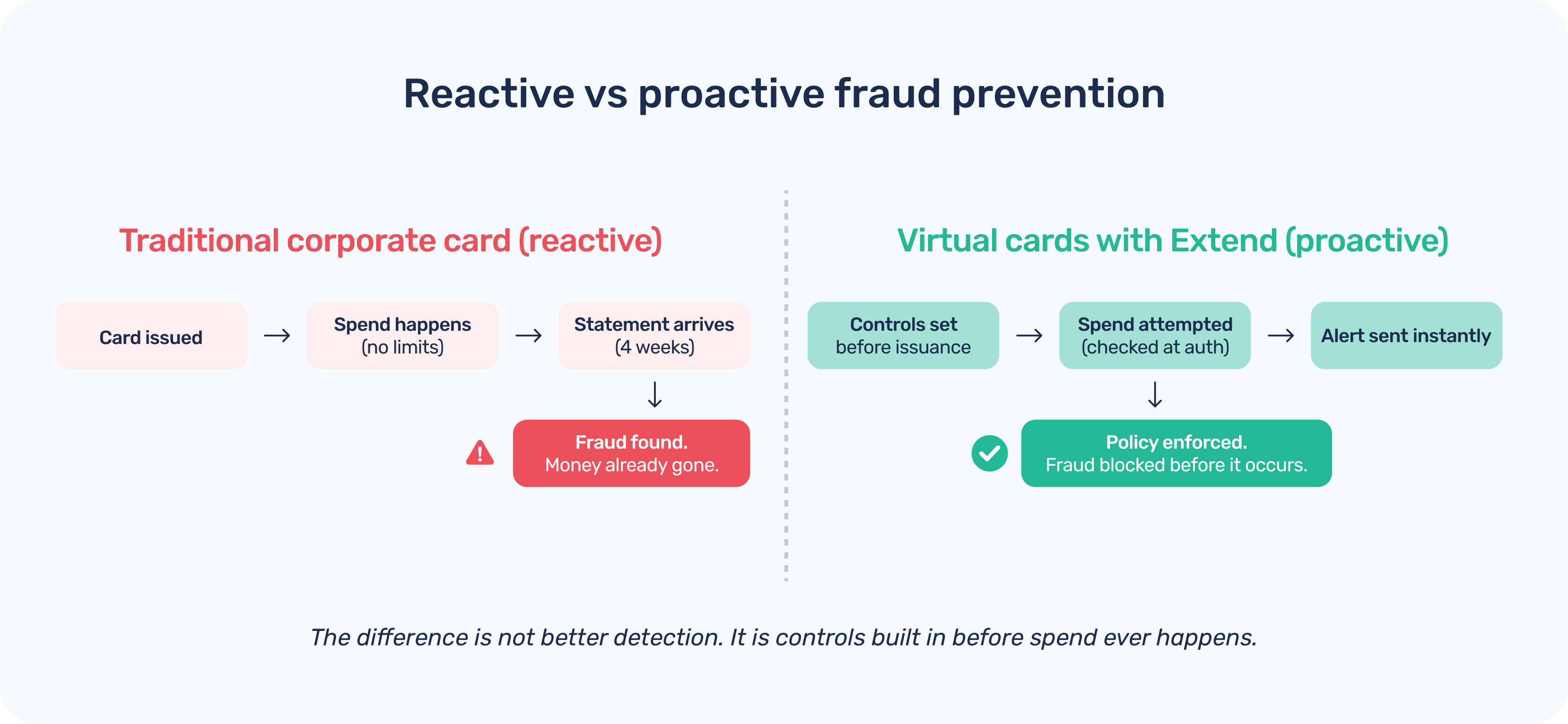
The way most corporate card programs work is fundamentally reactive. Typically, it looks like this: A card is issued, an employee uses it, transactions appear on a monthly statement, a manager or finance team member reviews the statement, flags anything that looks unusual, and requests documentation after the fact. If something is wrong, you find out weeks later.
This model made sense when corporate cards were issued to a small group of senior employees, transaction volumes were low, and the finance team had time to personally review every line item. It doesn't hold up when you have dozens or hundreds of cardholders across multiple teams, spend happening in dozens of currencies and time zones, and a reconciliation cycle that is already stretched thin.
The deeper problem is that retroactive review creates the wrong incentives. Employees know their expenses will be reviewed eventually, but the review feels distant enough that most people don't think about policy at the moment of purchase. Fraud and policy violations tend to be discovered not because the review process is good, but because someone makes a mistake that is too obvious to miss. Subtle, ongoing issues can persist for months.
Virtual cards work differently. Instead of issuing a single card that can be used broadly and reviewing the results later, you create a purpose-built card for each use case, with parameters set before the first transaction ever occurs.
The phrase "controls at the point of authorization" means that when a transaction is attempted, the payment network checks it against the parameters you set when you created the card. If the transaction falls outside those parameters, it can decline automatically, in real time, before any money moves. The control is not a policy someone is expected to follow, but a technical constraint that makes non-compliant transactions impossible.
This is a meaningfully different approach to fraud prevention. You aren't relying on employees to remember the rules. You aren't hoping that the monthly review catches something. You're making the thing you don't want to allow structurally impossible to execute.
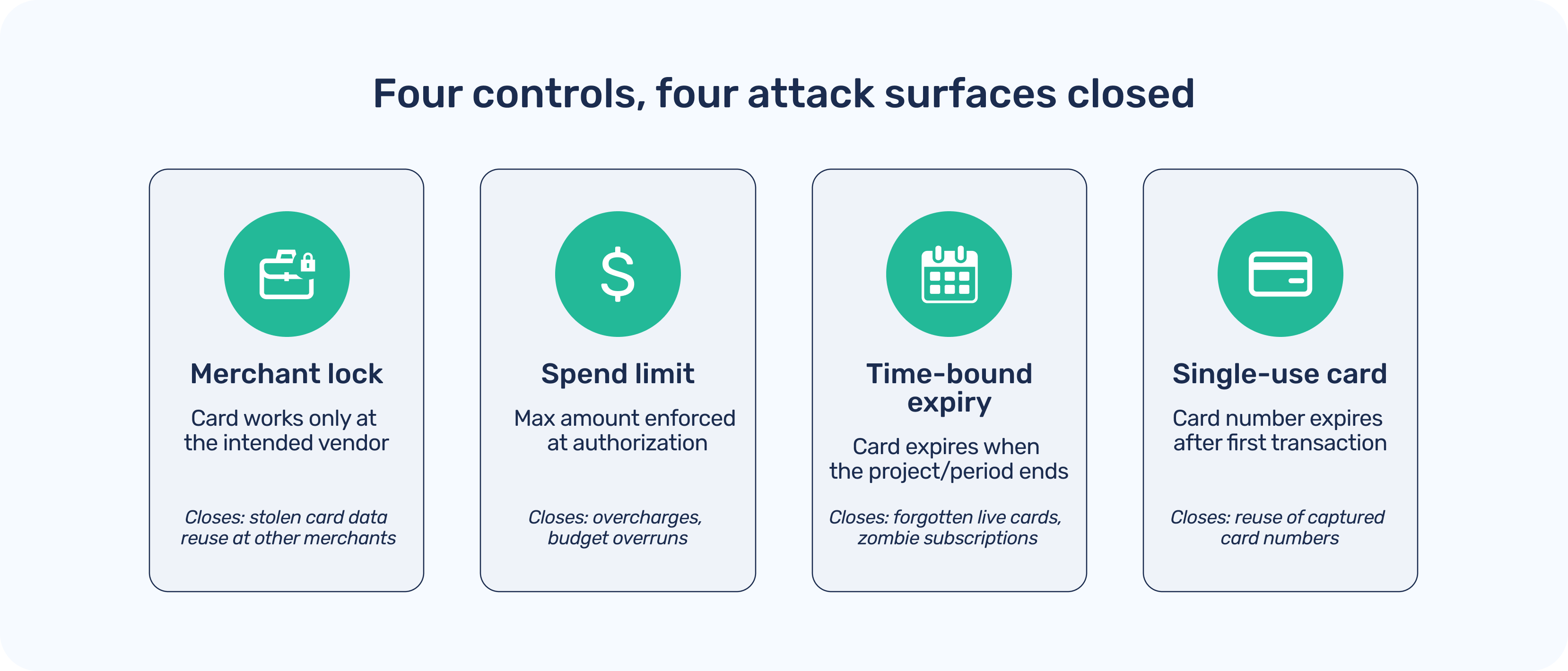
Not all virtual card controls are created equal. The ones that matter most for fraud prevention fall into four categories, each addressing a different attack surface.
A merchant-locked virtual card can only be used at a specific vendor. If the card number is compromised, it's useless everywhere except the intended merchant. This is particularly valuable for software subscriptions, where you want a single vendor locked in, and for contractor payments, where the card should only work for the specific payee. A card that can only be used at one place is not worth stealing.
Setting a maximum transaction amount or a total card limit caps the exposure from any single card. A vendor can't charge more than the authorized amount, even if they have your card on file. An employee can't overspend their budget because the authorization will fail once the limit is reached. This isn't about distrusting employees, but a helpful tool to make policy enforcement automatic.
A card that expires when a project ends or a subscription renewal date passes eliminates the entire category of "forgotten active card" fraud. Most companies have cards that were issued for one-time purposes and then left active because no one went back to close them. Those are live attack surfaces, sitting quietly in vendor billing systems. Time-bound cards make this problem self-correcting.
For true one-time transactions, a single-use virtual card generates a unique number that becomes invalid after the first charge. Even if that number is captured in a data breach or phishing attempt, it can't be used again. For vendor onboarding, one-time contractor payments, or any purchase where you don't want a recurring relationship, single-use cards are the cleanest solution.
Controls at the point of authorization handle the cases you can predict in advance. But not all fraud is predictable. Vendors miscategorize transactions. Employees make genuine mistakes that still represent policy violations. Accounts get compromised through channels that pre-set parameters don't cover.
For these cases, real-time visibility is the second layer. When every transaction generates an immediate notification, anomalies surface in minutes rather than weeks. A charge at an unexpected time or for an unusual amount is visible before the day ends, not at the next reconciliation cycle.
Extend's receipt requirement settings add another layer here. When cardholders are required to attach a receipt to every transaction at the time of purchase, the finance team builds a real-time picture of what was bought, where, and for what purpose. An expense that cannot be documented cannot simply slip through under a vague line item. The audit trail is created in the moment, not reconstructed weeks later when context has faded.
There is a version of this conversation that frames fraud prevention as an adversarial exercise: finance versus employees, controls as constraints, visibility as surveillance. But that framing misses the actual value.
Well-designed spending controls are not about distrust. They are about making it easy for employees to do the right thing without having to think about it. When a cardholder has a virtual card with a clear limit and a specific merchant scope, they don't need to consult the expense policy before every purchase. The card itself enforces the policy. There is no ambiguity, no second-guessing, and no retroactive dispute about whether a purchase was within guidelines.
This shifts the relationship between finance and the rest of the organization. Instead of finance acting as the compliance enforcer who shows up after the fact with problems, they become the team that gave everyone clarity and tools to operate correctly from the start. That is a different dynamic, and it is a better one.
Extend's Custom Fields amplify this principle into the data layer. Finance teams define the fields they need, like cost center, project code, or GL account. Cardholders fill them in when they submit their receipt. The data that used to require back-and-forth email chains is captured at the point of purchase, when context is fresh and accurate. Reconciliation then becomes a review process rather than a search-and-reconstruct process.
The practical question finance teams often ask is: do we need to switch banks, open new accounts, or go through a lengthy procurement process to get this kind of infrastructure in place?
With Extend, the answer is fortunately no.
Extend works with the business credit cards you already have, adding a control and visibility layer on top, allowing you to keep your existing rewards, credit lines, and banking relationships.
Setup is measured in hours, not months. Finance teams can typically issue their first virtual card in just a couple of minutes. From there, you can build out the full control framework: merchant restrictions, spend limits, time windows, receipt requirements, and custom expense fields, all configured through a clean interface that your team can manage without IT involvement.
Extend also integrates directly with the accounting systems your team already uses, including QuickBooks Online, QuickBooks Desktop, NetSuite, Xero, Sage Intacct, and Microsoft Dynamics 365 Business Central. Every transaction, with its associated metadata and receipt, syncs to your books in near real-time. The reconciliation work that used to pile up at month-end gets distributed across the month as transactions occur.
The goal isn't to make payment fraud impossible in some theoretical sense. It's to make it structurally difficult, to surface anomalies before they compound, and to build an audit trail that makes your financial operations defensible whether you're talking to an auditor, a board member, or simply trying to close the books cleanly. That is what good controls deliver, and it's well within reach for any finance team that is willing to move from reactive to proactive.
Issue virtual cards with built-in controls, get real-time transaction visibility, and sync everything to your accounting system. All on your existing business credit card.
Dawn Lewis
Controller at Couranto
Bridget Cobb
Staff Accountant at Healthstream
Brittany Nolan
Sr. Product Marketing Manager at Extend (moderator)

Every finance team knows the feeling. Someone spots a charge that doesn't look right. You pull the statement. The transaction is three weeks old, the vendor is unfamiliar, and now you're working backward through approvals trying to figure out whether someone authorized this or not. By the time you have an answer, the money is gone, the month is closed, and you're filing a dispute that may or may not be resolved in your favor.
This is how most businesses experience payment fraud. Not through real-time alerts, not through automatic blocks, but through retrospective discovery. And as payment volumes grow and spend gets distributed across more people and more vendors, the problem does not get smaller on its own.
The good news is that most business payment fraud is preventable. Not at the detection layer, not through better forensics, but at the authorization layer. With the right card infrastructure, the majority of fraudulent transactions simply can't happen in the first place.
The Association for Financial Professionals surveys finance executives annually on fraud attempts, and year after year, the results show that the majority of organizations have been targeted. Check fraud remains the most common vector, but card fraud, ACH fraud, and wire fraud are all growing as transaction volumes shift online and spending becomes more distributed across teams.
Several dynamics are making the problem worse. Remote and hybrid work has expanded the number of people who need access to corporate payment methods. Software subscription sprawl means more vendors, more recurring charges, and more opportunities for unauthorized or simply forgotten billing. And as companies scale, the informal trust networks that once made manual oversight practical no longer cover the full span of who is spending what.
Finance teams are also contending with a subtler category of loss: not outright fraud, but unauthorized or policy-violating spend that falls through the gaps of a reactive review process. This can look like an employee using a corporate card for a personal expense, a vendor charging a renewal that was supposed to be cancelled, or a contractor's one-time payment card getting used a second time. None of these are necessarily malicious, but they all represent money leaving the business outside of authorized channels.
The way most corporate card programs work is fundamentally reactive. Typically, it looks like this: A card is issued, an employee uses it, transactions appear on a monthly statement, a manager or finance team member reviews the statement, flags anything that looks unusual, and requests documentation after the fact. If something is wrong, you find out weeks later.
This model made sense when corporate cards were issued to a small group of senior employees, transaction volumes were low, and the finance team had time to personally review every line item. It doesn't hold up when you have dozens or hundreds of cardholders across multiple teams, spend happening in dozens of currencies and time zones, and a reconciliation cycle that is already stretched thin.
The deeper problem is that retroactive review creates the wrong incentives. Employees know their expenses will be reviewed eventually, but the review feels distant enough that most people don't think about policy at the moment of purchase. Fraud and policy violations tend to be discovered not because the review process is good, but because someone makes a mistake that is too obvious to miss. Subtle, ongoing issues can persist for months.
Virtual cards work differently. Instead of issuing a single card that can be used broadly and reviewing the results later, you create a purpose-built card for each use case, with parameters set before the first transaction ever occurs.
The phrase "controls at the point of authorization" means that when a transaction is attempted, the payment network checks it against the parameters you set when you created the card. If the transaction falls outside those parameters, it can decline automatically, in real time, before any money moves. The control is not a policy someone is expected to follow, but a technical constraint that makes non-compliant transactions impossible.
This is a meaningfully different approach to fraud prevention. You aren't relying on employees to remember the rules. You aren't hoping that the monthly review catches something. You're making the thing you don't want to allow structurally impossible to execute.
Not all virtual card controls are created equal. The ones that matter most for fraud prevention fall into four categories, each addressing a different attack surface.
A merchant-locked virtual card can only be used at a specific vendor. If the card number is compromised, it's useless everywhere except the intended merchant. This is particularly valuable for software subscriptions, where you want a single vendor locked in, and for contractor payments, where the card should only work for the specific payee. A card that can only be used at one place is not worth stealing.
Setting a maximum transaction amount or a total card limit caps the exposure from any single card. A vendor can't charge more than the authorized amount, even if they have your card on file. An employee can't overspend their budget because the authorization will fail once the limit is reached. This isn't about distrusting employees, but a helpful tool to make policy enforcement automatic.
A card that expires when a project ends or a subscription renewal date passes eliminates the entire category of "forgotten active card" fraud. Most companies have cards that were issued for one-time purposes and then left active because no one went back to close them. Those are live attack surfaces, sitting quietly in vendor billing systems. Time-bound cards make this problem self-correcting.
For true one-time transactions, a single-use virtual card generates a unique number that becomes invalid after the first charge. Even if that number is captured in a data breach or phishing attempt, it can't be used again. For vendor onboarding, one-time contractor payments, or any purchase where you don't want a recurring relationship, single-use cards are the cleanest solution.
Controls at the point of authorization handle the cases you can predict in advance. But not all fraud is predictable. Vendors miscategorize transactions. Employees make genuine mistakes that still represent policy violations. Accounts get compromised through channels that pre-set parameters don't cover.
For these cases, real-time visibility is the second layer. When every transaction generates an immediate notification, anomalies surface in minutes rather than weeks. A charge at an unexpected time or for an unusual amount is visible before the day ends, not at the next reconciliation cycle.
Extend's receipt requirement settings add another layer here. When cardholders are required to attach a receipt to every transaction at the time of purchase, the finance team builds a real-time picture of what was bought, where, and for what purpose. An expense that cannot be documented cannot simply slip through under a vague line item. The audit trail is created in the moment, not reconstructed weeks later when context has faded.
There is a version of this conversation that frames fraud prevention as an adversarial exercise: finance versus employees, controls as constraints, visibility as surveillance. But that framing misses the actual value.
Well-designed spending controls are not about distrust. They are about making it easy for employees to do the right thing without having to think about it. When a cardholder has a virtual card with a clear limit and a specific merchant scope, they don't need to consult the expense policy before every purchase. The card itself enforces the policy. There is no ambiguity, no second-guessing, and no retroactive dispute about whether a purchase was within guidelines.
This shifts the relationship between finance and the rest of the organization. Instead of finance acting as the compliance enforcer who shows up after the fact with problems, they become the team that gave everyone clarity and tools to operate correctly from the start. That is a different dynamic, and it is a better one.
Extend's Custom Fields amplify this principle into the data layer. Finance teams define the fields they need, like cost center, project code, or GL account. Cardholders fill them in when they submit their receipt. The data that used to require back-and-forth email chains is captured at the point of purchase, when context is fresh and accurate. Reconciliation then becomes a review process rather than a search-and-reconstruct process.
The practical question finance teams often ask is: do we need to switch banks, open new accounts, or go through a lengthy procurement process to get this kind of infrastructure in place?
With Extend, the answer is fortunately no.
Extend works with the business credit cards you already have, adding a control and visibility layer on top, allowing you to keep your existing rewards, credit lines, and banking relationships.
Setup is measured in hours, not months. Finance teams can typically issue their first virtual card in just a couple of minutes. From there, you can build out the full control framework: merchant restrictions, spend limits, time windows, receipt requirements, and custom expense fields, all configured through a clean interface that your team can manage without IT involvement.
Extend also integrates directly with the accounting systems your team already uses, including QuickBooks Online, QuickBooks Desktop, NetSuite, Xero, Sage Intacct, and Microsoft Dynamics 365 Business Central. Every transaction, with its associated metadata and receipt, syncs to your books in near real-time. The reconciliation work that used to pile up at month-end gets distributed across the month as transactions occur.
The goal isn't to make payment fraud impossible in some theoretical sense. It's to make it structurally difficult, to surface anomalies before they compound, and to build an audit trail that makes your financial operations defensible whether you're talking to an auditor, a board member, or simply trying to close the books cleanly. That is what good controls deliver, and it's well within reach for any finance team that is willing to move from reactive to proactive.
Issue virtual cards with built-in controls, get real-time transaction visibility, and sync everything to your accounting system. All on your existing business credit card.
Every finance team knows the feeling. Someone spots a charge that doesn't look right. You pull the statement. The transaction is three weeks old, the vendor is unfamiliar, and now you're working backward through approvals trying to figure out whether someone authorized this or not. By the time you have an answer, the money is gone, the month is closed, and you're filing a dispute that may or may not be resolved in your favor.
This is how most businesses experience payment fraud. Not through real-time alerts, not through automatic blocks, but through retrospective discovery. And as payment volumes grow and spend gets distributed across more people and more vendors, the problem does not get smaller on its own.
The good news is that most business payment fraud is preventable. Not at the detection layer, not through better forensics, but at the authorization layer. With the right card infrastructure, the majority of fraudulent transactions simply can't happen in the first place.
The Association for Financial Professionals surveys finance executives annually on fraud attempts, and year after year, the results show that the majority of organizations have been targeted. Check fraud remains the most common vector, but card fraud, ACH fraud, and wire fraud are all growing as transaction volumes shift online and spending becomes more distributed across teams.
Several dynamics are making the problem worse. Remote and hybrid work has expanded the number of people who need access to corporate payment methods. Software subscription sprawl means more vendors, more recurring charges, and more opportunities for unauthorized or simply forgotten billing. And as companies scale, the informal trust networks that once made manual oversight practical no longer cover the full span of who is spending what.
Finance teams are also contending with a subtler category of loss: not outright fraud, but unauthorized or policy-violating spend that falls through the gaps of a reactive review process. This can look like an employee using a corporate card for a personal expense, a vendor charging a renewal that was supposed to be cancelled, or a contractor's one-time payment card getting used a second time. None of these are necessarily malicious, but they all represent money leaving the business outside of authorized channels.
The way most corporate card programs work is fundamentally reactive. Typically, it looks like this: A card is issued, an employee uses it, transactions appear on a monthly statement, a manager or finance team member reviews the statement, flags anything that looks unusual, and requests documentation after the fact. If something is wrong, you find out weeks later.
This model made sense when corporate cards were issued to a small group of senior employees, transaction volumes were low, and the finance team had time to personally review every line item. It doesn't hold up when you have dozens or hundreds of cardholders across multiple teams, spend happening in dozens of currencies and time zones, and a reconciliation cycle that is already stretched thin.
The deeper problem is that retroactive review creates the wrong incentives. Employees know their expenses will be reviewed eventually, but the review feels distant enough that most people don't think about policy at the moment of purchase. Fraud and policy violations tend to be discovered not because the review process is good, but because someone makes a mistake that is too obvious to miss. Subtle, ongoing issues can persist for months.
Virtual cards work differently. Instead of issuing a single card that can be used broadly and reviewing the results later, you create a purpose-built card for each use case, with parameters set before the first transaction ever occurs.
The phrase "controls at the point of authorization" means that when a transaction is attempted, the payment network checks it against the parameters you set when you created the card. If the transaction falls outside those parameters, it can decline automatically, in real time, before any money moves. The control is not a policy someone is expected to follow, but a technical constraint that makes non-compliant transactions impossible.
This is a meaningfully different approach to fraud prevention. You aren't relying on employees to remember the rules. You aren't hoping that the monthly review catches something. You're making the thing you don't want to allow structurally impossible to execute.
Not all virtual card controls are created equal. The ones that matter most for fraud prevention fall into four categories, each addressing a different attack surface.
A merchant-locked virtual card can only be used at a specific vendor. If the card number is compromised, it's useless everywhere except the intended merchant. This is particularly valuable for software subscriptions, where you want a single vendor locked in, and for contractor payments, where the card should only work for the specific payee. A card that can only be used at one place is not worth stealing.
Setting a maximum transaction amount or a total card limit caps the exposure from any single card. A vendor can't charge more than the authorized amount, even if they have your card on file. An employee can't overspend their budget because the authorization will fail once the limit is reached. This isn't about distrusting employees, but a helpful tool to make policy enforcement automatic.
A card that expires when a project ends or a subscription renewal date passes eliminates the entire category of "forgotten active card" fraud. Most companies have cards that were issued for one-time purposes and then left active because no one went back to close them. Those are live attack surfaces, sitting quietly in vendor billing systems. Time-bound cards make this problem self-correcting.
For true one-time transactions, a single-use virtual card generates a unique number that becomes invalid after the first charge. Even if that number is captured in a data breach or phishing attempt, it can't be used again. For vendor onboarding, one-time contractor payments, or any purchase where you don't want a recurring relationship, single-use cards are the cleanest solution.
Controls at the point of authorization handle the cases you can predict in advance. But not all fraud is predictable. Vendors miscategorize transactions. Employees make genuine mistakes that still represent policy violations. Accounts get compromised through channels that pre-set parameters don't cover.
For these cases, real-time visibility is the second layer. When every transaction generates an immediate notification, anomalies surface in minutes rather than weeks. A charge at an unexpected time or for an unusual amount is visible before the day ends, not at the next reconciliation cycle.
Extend's receipt requirement settings add another layer here. When cardholders are required to attach a receipt to every transaction at the time of purchase, the finance team builds a real-time picture of what was bought, where, and for what purpose. An expense that cannot be documented cannot simply slip through under a vague line item. The audit trail is created in the moment, not reconstructed weeks later when context has faded.
There is a version of this conversation that frames fraud prevention as an adversarial exercise: finance versus employees, controls as constraints, visibility as surveillance. But that framing misses the actual value.
Well-designed spending controls are not about distrust. They are about making it easy for employees to do the right thing without having to think about it. When a cardholder has a virtual card with a clear limit and a specific merchant scope, they don't need to consult the expense policy before every purchase. The card itself enforces the policy. There is no ambiguity, no second-guessing, and no retroactive dispute about whether a purchase was within guidelines.
This shifts the relationship between finance and the rest of the organization. Instead of finance acting as the compliance enforcer who shows up after the fact with problems, they become the team that gave everyone clarity and tools to operate correctly from the start. That is a different dynamic, and it is a better one.
Extend's Custom Fields amplify this principle into the data layer. Finance teams define the fields they need, like cost center, project code, or GL account. Cardholders fill them in when they submit their receipt. The data that used to require back-and-forth email chains is captured at the point of purchase, when context is fresh and accurate. Reconciliation then becomes a review process rather than a search-and-reconstruct process.
The practical question finance teams often ask is: do we need to switch banks, open new accounts, or go through a lengthy procurement process to get this kind of infrastructure in place?
With Extend, the answer is fortunately no.
Extend works with the business credit cards you already have, adding a control and visibility layer on top, allowing you to keep your existing rewards, credit lines, and banking relationships.
Setup is measured in hours, not months. Finance teams can typically issue their first virtual card in just a couple of minutes. From there, you can build out the full control framework: merchant restrictions, spend limits, time windows, receipt requirements, and custom expense fields, all configured through a clean interface that your team can manage without IT involvement.
Extend also integrates directly with the accounting systems your team already uses, including QuickBooks Online, QuickBooks Desktop, NetSuite, Xero, Sage Intacct, and Microsoft Dynamics 365 Business Central. Every transaction, with its associated metadata and receipt, syncs to your books in near real-time. The reconciliation work that used to pile up at month-end gets distributed across the month as transactions occur.
The goal isn't to make payment fraud impossible in some theoretical sense. It's to make it structurally difficult, to surface anomalies before they compound, and to build an audit trail that makes your financial operations defensible whether you're talking to an auditor, a board member, or simply trying to close the books cleanly. That is what good controls deliver, and it's well within reach for any finance team that is willing to move from reactive to proactive.
Issue virtual cards with built-in controls, get real-time transaction visibility, and sync everything to your accounting system. All on your existing business credit card.

Every finance team knows the feeling. Someone spots a charge that doesn't look right. You pull the statement. The transaction is three weeks old, the vendor is unfamiliar, and now you're working backward through approvals trying to figure out whether someone authorized this or not. By the time you have an answer, the money is gone, the month is closed, and you're filing a dispute that may or may not be resolved in your favor.
This is how most businesses experience payment fraud. Not through real-time alerts, not through automatic blocks, but through retrospective discovery. And as payment volumes grow and spend gets distributed across more people and more vendors, the problem does not get smaller on its own.
The good news is that most business payment fraud is preventable. Not at the detection layer, not through better forensics, but at the authorization layer. With the right card infrastructure, the majority of fraudulent transactions simply can't happen in the first place.
The Association for Financial Professionals surveys finance executives annually on fraud attempts, and year after year, the results show that the majority of organizations have been targeted. Check fraud remains the most common vector, but card fraud, ACH fraud, and wire fraud are all growing as transaction volumes shift online and spending becomes more distributed across teams.
Several dynamics are making the problem worse. Remote and hybrid work has expanded the number of people who need access to corporate payment methods. Software subscription sprawl means more vendors, more recurring charges, and more opportunities for unauthorized or simply forgotten billing. And as companies scale, the informal trust networks that once made manual oversight practical no longer cover the full span of who is spending what.
Finance teams are also contending with a subtler category of loss: not outright fraud, but unauthorized or policy-violating spend that falls through the gaps of a reactive review process. This can look like an employee using a corporate card for a personal expense, a vendor charging a renewal that was supposed to be cancelled, or a contractor's one-time payment card getting used a second time. None of these are necessarily malicious, but they all represent money leaving the business outside of authorized channels.
The way most corporate card programs work is fundamentally reactive. Typically, it looks like this: A card is issued, an employee uses it, transactions appear on a monthly statement, a manager or finance team member reviews the statement, flags anything that looks unusual, and requests documentation after the fact. If something is wrong, you find out weeks later.
This model made sense when corporate cards were issued to a small group of senior employees, transaction volumes were low, and the finance team had time to personally review every line item. It doesn't hold up when you have dozens or hundreds of cardholders across multiple teams, spend happening in dozens of currencies and time zones, and a reconciliation cycle that is already stretched thin.
The deeper problem is that retroactive review creates the wrong incentives. Employees know their expenses will be reviewed eventually, but the review feels distant enough that most people don't think about policy at the moment of purchase. Fraud and policy violations tend to be discovered not because the review process is good, but because someone makes a mistake that is too obvious to miss. Subtle, ongoing issues can persist for months.
Virtual cards work differently. Instead of issuing a single card that can be used broadly and reviewing the results later, you create a purpose-built card for each use case, with parameters set before the first transaction ever occurs.
The phrase "controls at the point of authorization" means that when a transaction is attempted, the payment network checks it against the parameters you set when you created the card. If the transaction falls outside those parameters, it can decline automatically, in real time, before any money moves. The control is not a policy someone is expected to follow, but a technical constraint that makes non-compliant transactions impossible.
This is a meaningfully different approach to fraud prevention. You aren't relying on employees to remember the rules. You aren't hoping that the monthly review catches something. You're making the thing you don't want to allow structurally impossible to execute.
Not all virtual card controls are created equal. The ones that matter most for fraud prevention fall into four categories, each addressing a different attack surface.
A merchant-locked virtual card can only be used at a specific vendor. If the card number is compromised, it's useless everywhere except the intended merchant. This is particularly valuable for software subscriptions, where you want a single vendor locked in, and for contractor payments, where the card should only work for the specific payee. A card that can only be used at one place is not worth stealing.
Setting a maximum transaction amount or a total card limit caps the exposure from any single card. A vendor can't charge more than the authorized amount, even if they have your card on file. An employee can't overspend their budget because the authorization will fail once the limit is reached. This isn't about distrusting employees, but a helpful tool to make policy enforcement automatic.
A card that expires when a project ends or a subscription renewal date passes eliminates the entire category of "forgotten active card" fraud. Most companies have cards that were issued for one-time purposes and then left active because no one went back to close them. Those are live attack surfaces, sitting quietly in vendor billing systems. Time-bound cards make this problem self-correcting.
For true one-time transactions, a single-use virtual card generates a unique number that becomes invalid after the first charge. Even if that number is captured in a data breach or phishing attempt, it can't be used again. For vendor onboarding, one-time contractor payments, or any purchase where you don't want a recurring relationship, single-use cards are the cleanest solution.
Controls at the point of authorization handle the cases you can predict in advance. But not all fraud is predictable. Vendors miscategorize transactions. Employees make genuine mistakes that still represent policy violations. Accounts get compromised through channels that pre-set parameters don't cover.
For these cases, real-time visibility is the second layer. When every transaction generates an immediate notification, anomalies surface in minutes rather than weeks. A charge at an unexpected time or for an unusual amount is visible before the day ends, not at the next reconciliation cycle.
Extend's receipt requirement settings add another layer here. When cardholders are required to attach a receipt to every transaction at the time of purchase, the finance team builds a real-time picture of what was bought, where, and for what purpose. An expense that cannot be documented cannot simply slip through under a vague line item. The audit trail is created in the moment, not reconstructed weeks later when context has faded.
There is a version of this conversation that frames fraud prevention as an adversarial exercise: finance versus employees, controls as constraints, visibility as surveillance. But that framing misses the actual value.
Well-designed spending controls are not about distrust. They are about making it easy for employees to do the right thing without having to think about it. When a cardholder has a virtual card with a clear limit and a specific merchant scope, they don't need to consult the expense policy before every purchase. The card itself enforces the policy. There is no ambiguity, no second-guessing, and no retroactive dispute about whether a purchase was within guidelines.
This shifts the relationship between finance and the rest of the organization. Instead of finance acting as the compliance enforcer who shows up after the fact with problems, they become the team that gave everyone clarity and tools to operate correctly from the start. That is a different dynamic, and it is a better one.
Extend's Custom Fields amplify this principle into the data layer. Finance teams define the fields they need, like cost center, project code, or GL account. Cardholders fill them in when they submit their receipt. The data that used to require back-and-forth email chains is captured at the point of purchase, when context is fresh and accurate. Reconciliation then becomes a review process rather than a search-and-reconstruct process.
The practical question finance teams often ask is: do we need to switch banks, open new accounts, or go through a lengthy procurement process to get this kind of infrastructure in place?
With Extend, the answer is fortunately no.
Extend works with the business credit cards you already have, adding a control and visibility layer on top, allowing you to keep your existing rewards, credit lines, and banking relationships.
Setup is measured in hours, not months. Finance teams can typically issue their first virtual card in just a couple of minutes. From there, you can build out the full control framework: merchant restrictions, spend limits, time windows, receipt requirements, and custom expense fields, all configured through a clean interface that your team can manage without IT involvement.
Extend also integrates directly with the accounting systems your team already uses, including QuickBooks Online, QuickBooks Desktop, NetSuite, Xero, Sage Intacct, and Microsoft Dynamics 365 Business Central. Every transaction, with its associated metadata and receipt, syncs to your books in near real-time. The reconciliation work that used to pile up at month-end gets distributed across the month as transactions occur.
The goal isn't to make payment fraud impossible in some theoretical sense. It's to make it structurally difficult, to surface anomalies before they compound, and to build an audit trail that makes your financial operations defensible whether you're talking to an auditor, a board member, or simply trying to close the books cleanly. That is what good controls deliver, and it's well within reach for any finance team that is willing to move from reactive to proactive.
Issue virtual cards with built-in controls, get real-time transaction visibility, and sync everything to your accounting system. All on your existing business credit card.
Learn more about Extend and find out if it's the right solution for your business.


%201.png)


%201.png)
