


Talk to the experts
Learn more about Extend and find out if it's the right solution for your business.
June 23, 2026 4:47 PM

Ask most finance teams how they catch out-of-policy spending, and the answer is some version of "we review it after it happens." A purchase gets made, an expense report gets filed, and weeks later, someone checks whether it should have been approved in the first place. By then, the card has already been charged, and the conversation is about clawing money back, not preventing the spend.
This isn't a discipline problem. It's a design problem. Most spend control systems were built to catch violations, not stop them — which means every policy is only as strong as someone's willingness to review every transaction. Here's why that approach breaks down at scale, and what it looks like to enforce policy at the moment of purchase instead.
Most finance teams have some version of the same workflow: an employee makes a purchase, submits an expense report — sometimes days or weeks later — and a manager or AP team reviews it for policy compliance. If something looks off, someone has to flag it, have a conversation, and potentially claw back a reimbursement.
This cycle has two fundamental problems. First, the money is already gone. Once a charge has cleared and a reimbursement is processed, walking it back is uncomfortable at best and practically impossible at worst. Second, the volume of transactions most growing companies generate makes a thorough review genuinely difficult. When a finance team is processing hundreds of expense line items per month, it's inevitable that things slip through.
The result is that out-of-policy spending doesn't just happen occasionally — it becomes routine. Employees learn what gets approved and what doesn't through trial and error, not through enforced guardrails. And finance teams spend a disproportionate amount of time on exceptions rather than strategic work.
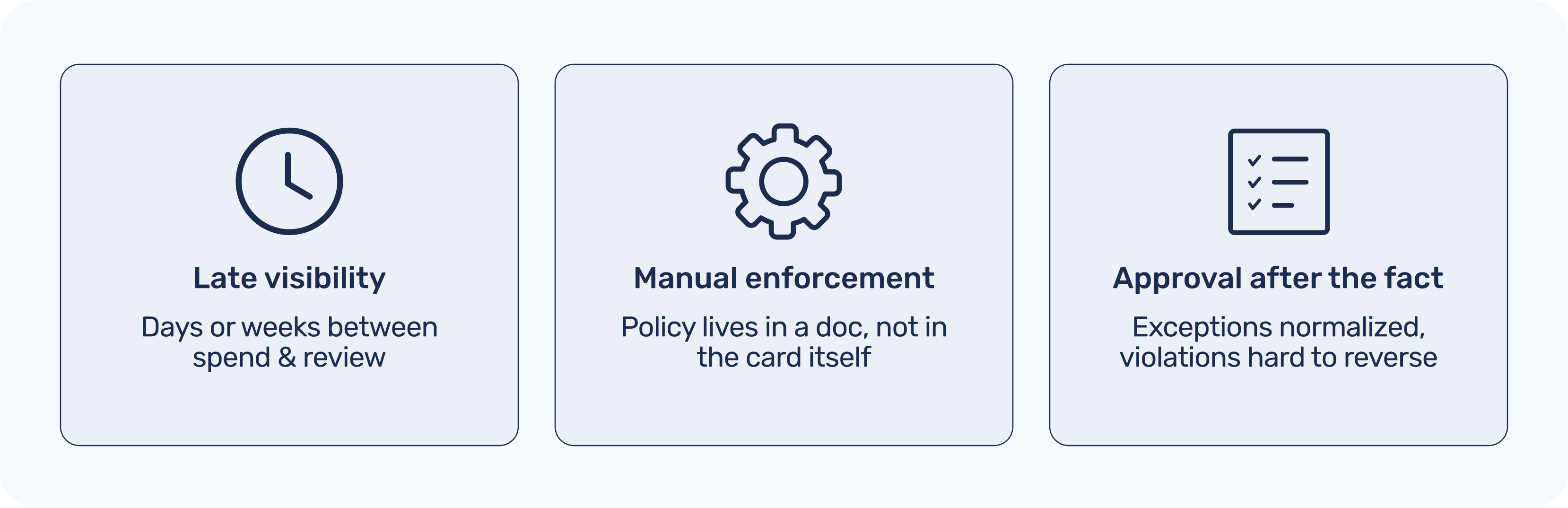
Spend control fragmentation usually isn't dramatic. It's a collection of small gaps that compound over time:
None of these are catastrophic on their own. Aggregated across a year, across a team of fifty people, they add up to real money — and real reconciliation headaches.
The most effective way to eliminate policy exceptions isn't to get better at reviewing them — it's to prevent them from happening in the first place. That requires moving enforcement to the moment of purchase, where a control can actually do something.
This is where virtual cards fundamentally change the equation. Rather than issuing a physical corporate card with broad permissions and hoping employees make good choices, a virtual card can be configured with specific rules before it's ever handed over:
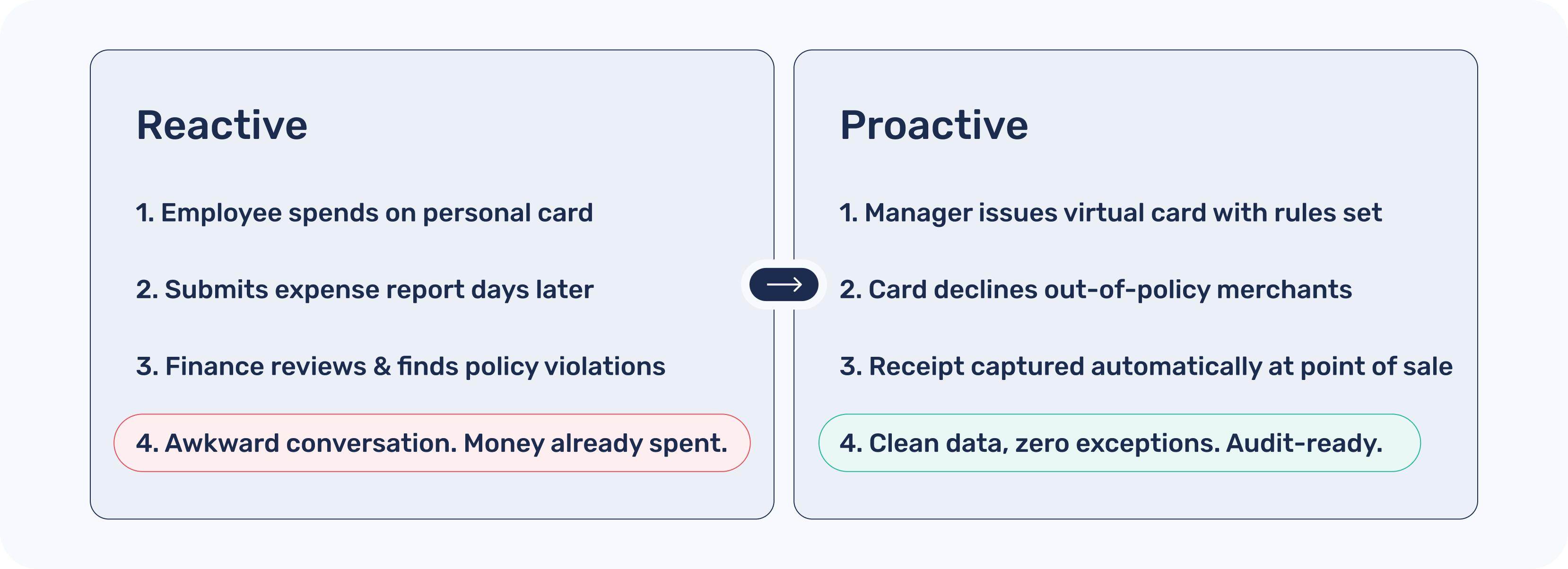
With Extend, managers can issue virtual cards directly from their existing corporate card program — no new banking relationship, no lengthy setup process. A card can be configured and sent in minutes, with the policy built in.
Most teams think of budgets as a planning artifact, a number agreed on at the start of a quarter that gets compared to actuals at the end. That framing puts the budget entirely in a backward-looking role.
A better model treats budget allocations as active controls. When a team is allocated $5,000 for Q3 software tools, that allocation should be enforced in real time — not discovered to be exceeded in the August close. Virtual card budgets inside Extend make this possible: a budget holder can be given a pool of spending authority that depletes as cards are issued and used, with visibility into the remaining balance at any moment.
This shifts the conversation between finance and department heads. Instead of "you went over budget last quarter," it becomes "you're at 80% of your Q3 software budget — do you want to request more or hold back?" That's a fundamentally different, and more productive, dynamic.
One of the most consistent points of friction in expense management is receipt collection. Employees make purchases, lose or forget receipts, and then reconstruct them days later when an expense report is due. Finance teams spend real time chasing documentation that should have been attached at the point of sale.
Extend's receipt management features allow receipts to be captured and matched to transactions immediately — either via the desktop and mobile app or through SMS. When a purchase is made on a virtual card, the employee gets a prompt to attach the receipt while it's still fresh. By the time the transaction appears in the finance team's view, it already has documentation attached.
This matters for more than convenience. Clean receipt documentation is essential for IRS substantiation requirements, particularly for business meals and travel. It also matters for audit readiness: having receipts attached to every transaction, in real time, is substantially easier to maintain than chasing them down retroactively before a close or an audit.
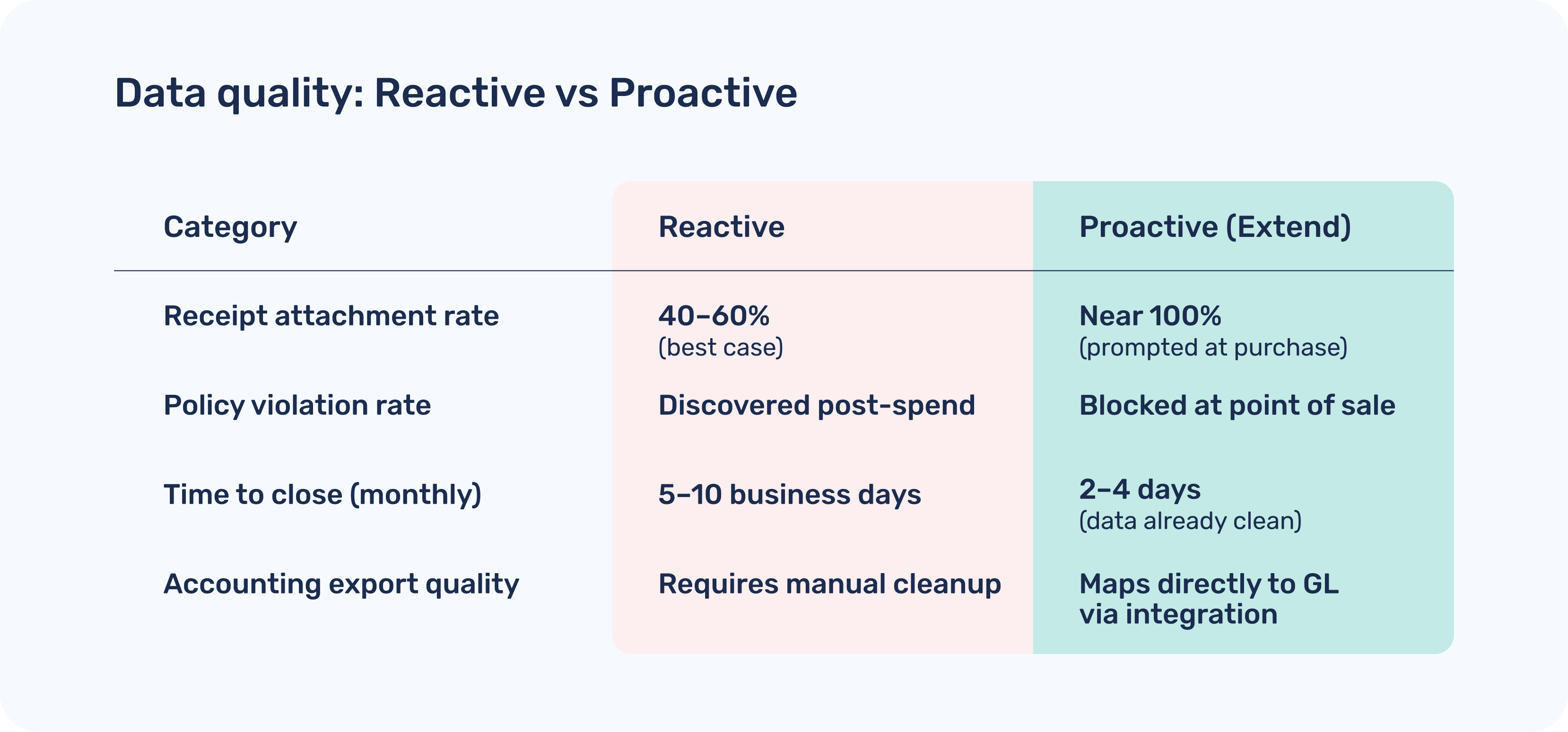
One of the less-discussed costs of reactive expense management is incomplete transaction data. When an employee submits an expense report two weeks after a trip, the details that make a transaction meaningful — the client it was for, the project it belongs to, the cost center it should hit — are harder to remember and often guessed at.
Extend's Additional Fields for Expense Capture lets finance teams define exactly what information needs to accompany each transaction — cost center, project code, client name, purpose — and collect it at the time of purchase, while the context is fresh. That data flows directly into accounting integrations with QuickBooks Online, QuickBooks Desktop, NetSuite, Xero, Sage Intacct, and Microsoft Dynamics 365 Business Central, so GL coding happens automatically rather than through a manual reconciliation process.
The practical effect is that the data entering your accounting system is accurate, complete, and consistently structured — not a best-effort reconstruction assembled from memory.
Finance teams sometimes respond to out-of-policy spending by tightening the policy — adding more rules, more required approvals, more paperwork. This often makes things worse. Overly restrictive policies slow down legitimate work, push employees toward workarounds, and create more exceptions, not fewer.
The goal isn't a longer policy document. It's a system where the existing policy is enforced automatically, without anyone needing to manually check whether each purchase complies. When the card itself contains the rules, policy compliance stops being a matter of employee discretion and becomes a structural feature of how spending works.
That's the shift proactive spend management makes possible — and it doesn't require renegotiating every team's expense policy to get there.
Extend is built for finance teams that want to issue spending authority without losing control. Here's what that looks like in practice:
The result is a spend & expense management workflow where your controls are built into the transaction — not bolted on afterward through manual review.
Dawn Lewis
Controller at Couranto
Bridget Cobb
Staff Accountant at Healthstream
Brittany Nolan
Sr. Product Marketing Manager at Extend (moderator)

Ask most finance teams how they catch out-of-policy spending, and the answer is some version of "we review it after it happens." A purchase gets made, an expense report gets filed, and weeks later, someone checks whether it should have been approved in the first place. By then, the card has already been charged, and the conversation is about clawing money back, not preventing the spend.
This isn't a discipline problem. It's a design problem. Most spend control systems were built to catch violations, not stop them — which means every policy is only as strong as someone's willingness to review every transaction. Here's why that approach breaks down at scale, and what it looks like to enforce policy at the moment of purchase instead.
Most finance teams have some version of the same workflow: an employee makes a purchase, submits an expense report — sometimes days or weeks later — and a manager or AP team reviews it for policy compliance. If something looks off, someone has to flag it, have a conversation, and potentially claw back a reimbursement.
This cycle has two fundamental problems. First, the money is already gone. Once a charge has cleared and a reimbursement is processed, walking it back is uncomfortable at best and practically impossible at worst. Second, the volume of transactions most growing companies generate makes a thorough review genuinely difficult. When a finance team is processing hundreds of expense line items per month, it's inevitable that things slip through.
The result is that out-of-policy spending doesn't just happen occasionally — it becomes routine. Employees learn what gets approved and what doesn't through trial and error, not through enforced guardrails. And finance teams spend a disproportionate amount of time on exceptions rather than strategic work.
Spend control fragmentation usually isn't dramatic. It's a collection of small gaps that compound over time:
None of these are catastrophic on their own. Aggregated across a year, across a team of fifty people, they add up to real money — and real reconciliation headaches.
The most effective way to eliminate policy exceptions isn't to get better at reviewing them — it's to prevent them from happening in the first place. That requires moving enforcement to the moment of purchase, where a control can actually do something.
This is where virtual cards fundamentally change the equation. Rather than issuing a physical corporate card with broad permissions and hoping employees make good choices, a virtual card can be configured with specific rules before it's ever handed over:
With Extend, managers can issue virtual cards directly from their existing corporate card program — no new banking relationship, no lengthy setup process. A card can be configured and sent in minutes, with the policy built in.
Most teams think of budgets as a planning artifact, a number agreed on at the start of a quarter that gets compared to actuals at the end. That framing puts the budget entirely in a backward-looking role.
A better model treats budget allocations as active controls. When a team is allocated $5,000 for Q3 software tools, that allocation should be enforced in real time — not discovered to be exceeded in the August close. Virtual card budgets inside Extend make this possible: a budget holder can be given a pool of spending authority that depletes as cards are issued and used, with visibility into the remaining balance at any moment.
This shifts the conversation between finance and department heads. Instead of "you went over budget last quarter," it becomes "you're at 80% of your Q3 software budget — do you want to request more or hold back?" That's a fundamentally different, and more productive, dynamic.
One of the most consistent points of friction in expense management is receipt collection. Employees make purchases, lose or forget receipts, and then reconstruct them days later when an expense report is due. Finance teams spend real time chasing documentation that should have been attached at the point of sale.
Extend's receipt management features allow receipts to be captured and matched to transactions immediately — either via the desktop and mobile app or through SMS. When a purchase is made on a virtual card, the employee gets a prompt to attach the receipt while it's still fresh. By the time the transaction appears in the finance team's view, it already has documentation attached.
This matters for more than convenience. Clean receipt documentation is essential for IRS substantiation requirements, particularly for business meals and travel. It also matters for audit readiness: having receipts attached to every transaction, in real time, is substantially easier to maintain than chasing them down retroactively before a close or an audit.
One of the less-discussed costs of reactive expense management is incomplete transaction data. When an employee submits an expense report two weeks after a trip, the details that make a transaction meaningful — the client it was for, the project it belongs to, the cost center it should hit — are harder to remember and often guessed at.
Extend's Additional Fields for Expense Capture lets finance teams define exactly what information needs to accompany each transaction — cost center, project code, client name, purpose — and collect it at the time of purchase, while the context is fresh. That data flows directly into accounting integrations with QuickBooks Online, QuickBooks Desktop, NetSuite, Xero, Sage Intacct, and Microsoft Dynamics 365 Business Central, so GL coding happens automatically rather than through a manual reconciliation process.
The practical effect is that the data entering your accounting system is accurate, complete, and consistently structured — not a best-effort reconstruction assembled from memory.
Finance teams sometimes respond to out-of-policy spending by tightening the policy — adding more rules, more required approvals, more paperwork. This often makes things worse. Overly restrictive policies slow down legitimate work, push employees toward workarounds, and create more exceptions, not fewer.
The goal isn't a longer policy document. It's a system where the existing policy is enforced automatically, without anyone needing to manually check whether each purchase complies. When the card itself contains the rules, policy compliance stops being a matter of employee discretion and becomes a structural feature of how spending works.
That's the shift proactive spend management makes possible — and it doesn't require renegotiating every team's expense policy to get there.
Extend is built for finance teams that want to issue spending authority without losing control. Here's what that looks like in practice:
The result is a spend & expense management workflow where your controls are built into the transaction — not bolted on afterward through manual review.
Ask most finance teams how they catch out-of-policy spending, and the answer is some version of "we review it after it happens." A purchase gets made, an expense report gets filed, and weeks later, someone checks whether it should have been approved in the first place. By then, the card has already been charged, and the conversation is about clawing money back, not preventing the spend.
This isn't a discipline problem. It's a design problem. Most spend control systems were built to catch violations, not stop them — which means every policy is only as strong as someone's willingness to review every transaction. Here's why that approach breaks down at scale, and what it looks like to enforce policy at the moment of purchase instead.
Most finance teams have some version of the same workflow: an employee makes a purchase, submits an expense report — sometimes days or weeks later — and a manager or AP team reviews it for policy compliance. If something looks off, someone has to flag it, have a conversation, and potentially claw back a reimbursement.
This cycle has two fundamental problems. First, the money is already gone. Once a charge has cleared and a reimbursement is processed, walking it back is uncomfortable at best and practically impossible at worst. Second, the volume of transactions most growing companies generate makes a thorough review genuinely difficult. When a finance team is processing hundreds of expense line items per month, it's inevitable that things slip through.
The result is that out-of-policy spending doesn't just happen occasionally — it becomes routine. Employees learn what gets approved and what doesn't through trial and error, not through enforced guardrails. And finance teams spend a disproportionate amount of time on exceptions rather than strategic work.
Spend control fragmentation usually isn't dramatic. It's a collection of small gaps that compound over time:
None of these are catastrophic on their own. Aggregated across a year, across a team of fifty people, they add up to real money — and real reconciliation headaches.
The most effective way to eliminate policy exceptions isn't to get better at reviewing them — it's to prevent them from happening in the first place. That requires moving enforcement to the moment of purchase, where a control can actually do something.
This is where virtual cards fundamentally change the equation. Rather than issuing a physical corporate card with broad permissions and hoping employees make good choices, a virtual card can be configured with specific rules before it's ever handed over:
With Extend, managers can issue virtual cards directly from their existing corporate card program — no new banking relationship, no lengthy setup process. A card can be configured and sent in minutes, with the policy built in.
Most teams think of budgets as a planning artifact, a number agreed on at the start of a quarter that gets compared to actuals at the end. That framing puts the budget entirely in a backward-looking role.
A better model treats budget allocations as active controls. When a team is allocated $5,000 for Q3 software tools, that allocation should be enforced in real time — not discovered to be exceeded in the August close. Virtual card budgets inside Extend make this possible: a budget holder can be given a pool of spending authority that depletes as cards are issued and used, with visibility into the remaining balance at any moment.
This shifts the conversation between finance and department heads. Instead of "you went over budget last quarter," it becomes "you're at 80% of your Q3 software budget — do you want to request more or hold back?" That's a fundamentally different, and more productive, dynamic.
One of the most consistent points of friction in expense management is receipt collection. Employees make purchases, lose or forget receipts, and then reconstruct them days later when an expense report is due. Finance teams spend real time chasing documentation that should have been attached at the point of sale.
Extend's receipt management features allow receipts to be captured and matched to transactions immediately — either via the desktop and mobile app or through SMS. When a purchase is made on a virtual card, the employee gets a prompt to attach the receipt while it's still fresh. By the time the transaction appears in the finance team's view, it already has documentation attached.
This matters for more than convenience. Clean receipt documentation is essential for IRS substantiation requirements, particularly for business meals and travel. It also matters for audit readiness: having receipts attached to every transaction, in real time, is substantially easier to maintain than chasing them down retroactively before a close or an audit.
One of the less-discussed costs of reactive expense management is incomplete transaction data. When an employee submits an expense report two weeks after a trip, the details that make a transaction meaningful — the client it was for, the project it belongs to, the cost center it should hit — are harder to remember and often guessed at.
Extend's Additional Fields for Expense Capture lets finance teams define exactly what information needs to accompany each transaction — cost center, project code, client name, purpose — and collect it at the time of purchase, while the context is fresh. That data flows directly into accounting integrations with QuickBooks Online, QuickBooks Desktop, NetSuite, Xero, Sage Intacct, and Microsoft Dynamics 365 Business Central, so GL coding happens automatically rather than through a manual reconciliation process.
The practical effect is that the data entering your accounting system is accurate, complete, and consistently structured — not a best-effort reconstruction assembled from memory.
Finance teams sometimes respond to out-of-policy spending by tightening the policy — adding more rules, more required approvals, more paperwork. This often makes things worse. Overly restrictive policies slow down legitimate work, push employees toward workarounds, and create more exceptions, not fewer.
The goal isn't a longer policy document. It's a system where the existing policy is enforced automatically, without anyone needing to manually check whether each purchase complies. When the card itself contains the rules, policy compliance stops being a matter of employee discretion and becomes a structural feature of how spending works.
That's the shift proactive spend management makes possible — and it doesn't require renegotiating every team's expense policy to get there.
Extend is built for finance teams that want to issue spending authority without losing control. Here's what that looks like in practice:
The result is a spend & expense management workflow where your controls are built into the transaction — not bolted on afterward through manual review.

Ask most finance teams how they catch out-of-policy spending, and the answer is some version of "we review it after it happens." A purchase gets made, an expense report gets filed, and weeks later, someone checks whether it should have been approved in the first place. By then, the card has already been charged, and the conversation is about clawing money back, not preventing the spend.
This isn't a discipline problem. It's a design problem. Most spend control systems were built to catch violations, not stop them — which means every policy is only as strong as someone's willingness to review every transaction. Here's why that approach breaks down at scale, and what it looks like to enforce policy at the moment of purchase instead.
Most finance teams have some version of the same workflow: an employee makes a purchase, submits an expense report — sometimes days or weeks later — and a manager or AP team reviews it for policy compliance. If something looks off, someone has to flag it, have a conversation, and potentially claw back a reimbursement.
This cycle has two fundamental problems. First, the money is already gone. Once a charge has cleared and a reimbursement is processed, walking it back is uncomfortable at best and practically impossible at worst. Second, the volume of transactions most growing companies generate makes a thorough review genuinely difficult. When a finance team is processing hundreds of expense line items per month, it's inevitable that things slip through.
The result is that out-of-policy spending doesn't just happen occasionally — it becomes routine. Employees learn what gets approved and what doesn't through trial and error, not through enforced guardrails. And finance teams spend a disproportionate amount of time on exceptions rather than strategic work.
Spend control fragmentation usually isn't dramatic. It's a collection of small gaps that compound over time:
None of these are catastrophic on their own. Aggregated across a year, across a team of fifty people, they add up to real money — and real reconciliation headaches.
The most effective way to eliminate policy exceptions isn't to get better at reviewing them — it's to prevent them from happening in the first place. That requires moving enforcement to the moment of purchase, where a control can actually do something.
This is where virtual cards fundamentally change the equation. Rather than issuing a physical corporate card with broad permissions and hoping employees make good choices, a virtual card can be configured with specific rules before it's ever handed over:
With Extend, managers can issue virtual cards directly from their existing corporate card program — no new banking relationship, no lengthy setup process. A card can be configured and sent in minutes, with the policy built in.
Most teams think of budgets as a planning artifact, a number agreed on at the start of a quarter that gets compared to actuals at the end. That framing puts the budget entirely in a backward-looking role.
A better model treats budget allocations as active controls. When a team is allocated $5,000 for Q3 software tools, that allocation should be enforced in real time — not discovered to be exceeded in the August close. Virtual card budgets inside Extend make this possible: a budget holder can be given a pool of spending authority that depletes as cards are issued and used, with visibility into the remaining balance at any moment.
This shifts the conversation between finance and department heads. Instead of "you went over budget last quarter," it becomes "you're at 80% of your Q3 software budget — do you want to request more or hold back?" That's a fundamentally different, and more productive, dynamic.
One of the most consistent points of friction in expense management is receipt collection. Employees make purchases, lose or forget receipts, and then reconstruct them days later when an expense report is due. Finance teams spend real time chasing documentation that should have been attached at the point of sale.
Extend's receipt management features allow receipts to be captured and matched to transactions immediately — either via the desktop and mobile app or through SMS. When a purchase is made on a virtual card, the employee gets a prompt to attach the receipt while it's still fresh. By the time the transaction appears in the finance team's view, it already has documentation attached.
This matters for more than convenience. Clean receipt documentation is essential for IRS substantiation requirements, particularly for business meals and travel. It also matters for audit readiness: having receipts attached to every transaction, in real time, is substantially easier to maintain than chasing them down retroactively before a close or an audit.
One of the less-discussed costs of reactive expense management is incomplete transaction data. When an employee submits an expense report two weeks after a trip, the details that make a transaction meaningful — the client it was for, the project it belongs to, the cost center it should hit — are harder to remember and often guessed at.
Extend's Additional Fields for Expense Capture lets finance teams define exactly what information needs to accompany each transaction — cost center, project code, client name, purpose — and collect it at the time of purchase, while the context is fresh. That data flows directly into accounting integrations with QuickBooks Online, QuickBooks Desktop, NetSuite, Xero, Sage Intacct, and Microsoft Dynamics 365 Business Central, so GL coding happens automatically rather than through a manual reconciliation process.
The practical effect is that the data entering your accounting system is accurate, complete, and consistently structured — not a best-effort reconstruction assembled from memory.
Finance teams sometimes respond to out-of-policy spending by tightening the policy — adding more rules, more required approvals, more paperwork. This often makes things worse. Overly restrictive policies slow down legitimate work, push employees toward workarounds, and create more exceptions, not fewer.
The goal isn't a longer policy document. It's a system where the existing policy is enforced automatically, without anyone needing to manually check whether each purchase complies. When the card itself contains the rules, policy compliance stops being a matter of employee discretion and becomes a structural feature of how spending works.
That's the shift proactive spend management makes possible — and it doesn't require renegotiating every team's expense policy to get there.
Extend is built for finance teams that want to issue spending authority without losing control. Here's what that looks like in practice:
The result is a spend & expense management workflow where your controls are built into the transaction — not bolted on afterward through manual review.
Learn more about Extend and find out if it's the right solution for your business.


%201.png)


%201.png)
