


Talk to the experts
Learn more about Extend and find out if it's the right solution for your business.
June 17, 2026 2:37 PM

Ask most controllers what the hardest part of month-end close is, and they will not say "the journal entries." They will say, "waiting for data from people who don't understand why it matters right now."
The accounting work in close is well understood. The process problems are almost always upstream: sales ops has not submitted their pipeline update, a team ran a late purchase that finance just found out about, and the expense reports from the last week of the month are still trickling in. These are not accounting problems. They are coordination problems. Here is how to build a close process that solves for them.
Before redesigning the close calendar, the most useful exercise is mapping every input that finance needs from outside the finance team. This usually includes: expense reports and corporate card transactions, purchase orders and invoice approvals, sales bookings and commission data, payroll finalization, and any operational metrics used in accrual estimates.
For each input, identify who owns it, when finance needs it, and what happens to close if it's late. This map almost always reveals a handful of critical path dependencies that are causing the bulk of close delays, and it gives you a concrete conversation to have with business partners about why their deadlines matter.
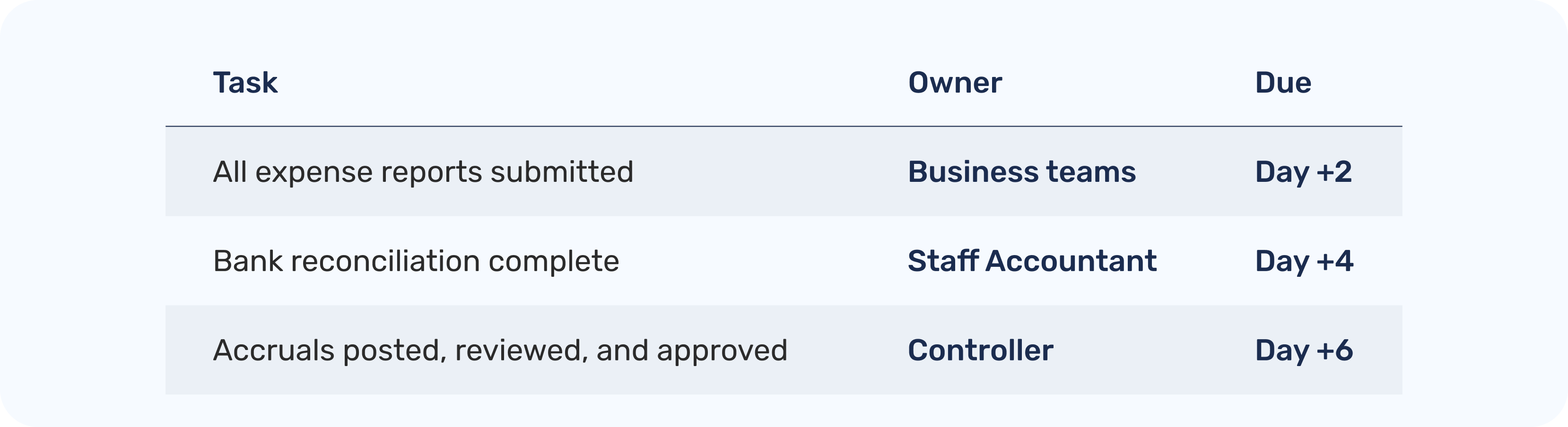
A close calendar only works if the dates mean something. "Submit expense reports by the 2nd" is a suggestion. "Expense reports submitted after the 2nd will be processed in the following month" is a policy. The latter changes behavior. Finance teams that are serious about close timelines usually have to enforce a hard cutoff at least once before it becomes credible. After that, most people comply.
The calendar should work backwards from the external deadline, board reporting, investor reporting, or audit requirements, and assign specific dates to each dependency, each reconciliation, and each sign-off. Each item should have a single owner and a clear output: not "reconcile accounts" but "bank rec signed off and filed by controller."
Corporate card and expense report data is one of the most common reasons close runs long. Employees submit late, receipts are missing, and coding is wrong. Finance ends up either processing an incomplete picture or waiting for stragglers and pushing everything back.
The structural fix is to move from reactive expense collection to real-time spend visibility. When every charge is visible to finance the moment it posts, the close process does not depend on employees submitting reports. Finance already has the data. The review is confirming context and coding, not hunting for information.
Most finance teams don't systematically track where time goes in close. They know it is hard. They know certain tasks always run late. But without data on which steps take the most time and which dependencies cause the most delays, improvement is guesswork.
The simplest version of close measurement is a log: for each task on the close calendar, record when it was supposed to be done and when it actually was done. After three months, patterns become clear. You will see which dependencies are consistently late, which team members are bottlenecks, and which tasks could be parallelized with better handoffs. That data drives targeted improvements instead of general exhortations to "move faster."
At Extend, real-time spend data means that corporate card transactions are visible to finance teams from day one of the month, with coding context built in. Close does not start with a data collection problem.
Dawn Lewis
Controller at Couranto
Bridget Cobb
Staff Accountant at Healthstream
Brittany Nolan
Sr. Product Marketing Manager at Extend (moderator)

Ask most controllers what the hardest part of month-end close is, and they will not say "the journal entries." They will say, "waiting for data from people who don't understand why it matters right now."
The accounting work in close is well understood. The process problems are almost always upstream: sales ops has not submitted their pipeline update, a team ran a late purchase that finance just found out about, and the expense reports from the last week of the month are still trickling in. These are not accounting problems. They are coordination problems. Here is how to build a close process that solves for them.
Before redesigning the close calendar, the most useful exercise is mapping every input that finance needs from outside the finance team. This usually includes: expense reports and corporate card transactions, purchase orders and invoice approvals, sales bookings and commission data, payroll finalization, and any operational metrics used in accrual estimates.
For each input, identify who owns it, when finance needs it, and what happens to close if it's late. This map almost always reveals a handful of critical path dependencies that are causing the bulk of close delays, and it gives you a concrete conversation to have with business partners about why their deadlines matter.
A close calendar only works if the dates mean something. "Submit expense reports by the 2nd" is a suggestion. "Expense reports submitted after the 2nd will be processed in the following month" is a policy. The latter changes behavior. Finance teams that are serious about close timelines usually have to enforce a hard cutoff at least once before it becomes credible. After that, most people comply.
The calendar should work backwards from the external deadline, board reporting, investor reporting, or audit requirements, and assign specific dates to each dependency, each reconciliation, and each sign-off. Each item should have a single owner and a clear output: not "reconcile accounts" but "bank rec signed off and filed by controller."
Corporate card and expense report data is one of the most common reasons close runs long. Employees submit late, receipts are missing, and coding is wrong. Finance ends up either processing an incomplete picture or waiting for stragglers and pushing everything back.
The structural fix is to move from reactive expense collection to real-time spend visibility. When every charge is visible to finance the moment it posts, the close process does not depend on employees submitting reports. Finance already has the data. The review is confirming context and coding, not hunting for information.
Most finance teams don't systematically track where time goes in close. They know it is hard. They know certain tasks always run late. But without data on which steps take the most time and which dependencies cause the most delays, improvement is guesswork.
The simplest version of close measurement is a log: for each task on the close calendar, record when it was supposed to be done and when it actually was done. After three months, patterns become clear. You will see which dependencies are consistently late, which team members are bottlenecks, and which tasks could be parallelized with better handoffs. That data drives targeted improvements instead of general exhortations to "move faster."
At Extend, real-time spend data means that corporate card transactions are visible to finance teams from day one of the month, with coding context built in. Close does not start with a data collection problem.
Ask most controllers what the hardest part of month-end close is, and they will not say "the journal entries." They will say, "waiting for data from people who don't understand why it matters right now."
The accounting work in close is well understood. The process problems are almost always upstream: sales ops has not submitted their pipeline update, a team ran a late purchase that finance just found out about, and the expense reports from the last week of the month are still trickling in. These are not accounting problems. They are coordination problems. Here is how to build a close process that solves for them.
Before redesigning the close calendar, the most useful exercise is mapping every input that finance needs from outside the finance team. This usually includes: expense reports and corporate card transactions, purchase orders and invoice approvals, sales bookings and commission data, payroll finalization, and any operational metrics used in accrual estimates.
For each input, identify who owns it, when finance needs it, and what happens to close if it's late. This map almost always reveals a handful of critical path dependencies that are causing the bulk of close delays, and it gives you a concrete conversation to have with business partners about why their deadlines matter.
A close calendar only works if the dates mean something. "Submit expense reports by the 2nd" is a suggestion. "Expense reports submitted after the 2nd will be processed in the following month" is a policy. The latter changes behavior. Finance teams that are serious about close timelines usually have to enforce a hard cutoff at least once before it becomes credible. After that, most people comply.
The calendar should work backwards from the external deadline, board reporting, investor reporting, or audit requirements, and assign specific dates to each dependency, each reconciliation, and each sign-off. Each item should have a single owner and a clear output: not "reconcile accounts" but "bank rec signed off and filed by controller."
Corporate card and expense report data is one of the most common reasons close runs long. Employees submit late, receipts are missing, and coding is wrong. Finance ends up either processing an incomplete picture or waiting for stragglers and pushing everything back.
The structural fix is to move from reactive expense collection to real-time spend visibility. When every charge is visible to finance the moment it posts, the close process does not depend on employees submitting reports. Finance already has the data. The review is confirming context and coding, not hunting for information.
Most finance teams don't systematically track where time goes in close. They know it is hard. They know certain tasks always run late. But without data on which steps take the most time and which dependencies cause the most delays, improvement is guesswork.
The simplest version of close measurement is a log: for each task on the close calendar, record when it was supposed to be done and when it actually was done. After three months, patterns become clear. You will see which dependencies are consistently late, which team members are bottlenecks, and which tasks could be parallelized with better handoffs. That data drives targeted improvements instead of general exhortations to "move faster."
At Extend, real-time spend data means that corporate card transactions are visible to finance teams from day one of the month, with coding context built in. Close does not start with a data collection problem.

Ask most controllers what the hardest part of month-end close is, and they will not say "the journal entries." They will say, "waiting for data from people who don't understand why it matters right now."
The accounting work in close is well understood. The process problems are almost always upstream: sales ops has not submitted their pipeline update, a team ran a late purchase that finance just found out about, and the expense reports from the last week of the month are still trickling in. These are not accounting problems. They are coordination problems. Here is how to build a close process that solves for them.
Before redesigning the close calendar, the most useful exercise is mapping every input that finance needs from outside the finance team. This usually includes: expense reports and corporate card transactions, purchase orders and invoice approvals, sales bookings and commission data, payroll finalization, and any operational metrics used in accrual estimates.
For each input, identify who owns it, when finance needs it, and what happens to close if it's late. This map almost always reveals a handful of critical path dependencies that are causing the bulk of close delays, and it gives you a concrete conversation to have with business partners about why their deadlines matter.
A close calendar only works if the dates mean something. "Submit expense reports by the 2nd" is a suggestion. "Expense reports submitted after the 2nd will be processed in the following month" is a policy. The latter changes behavior. Finance teams that are serious about close timelines usually have to enforce a hard cutoff at least once before it becomes credible. After that, most people comply.
The calendar should work backwards from the external deadline, board reporting, investor reporting, or audit requirements, and assign specific dates to each dependency, each reconciliation, and each sign-off. Each item should have a single owner and a clear output: not "reconcile accounts" but "bank rec signed off and filed by controller."
Corporate card and expense report data is one of the most common reasons close runs long. Employees submit late, receipts are missing, and coding is wrong. Finance ends up either processing an incomplete picture or waiting for stragglers and pushing everything back.
The structural fix is to move from reactive expense collection to real-time spend visibility. When every charge is visible to finance the moment it posts, the close process does not depend on employees submitting reports. Finance already has the data. The review is confirming context and coding, not hunting for information.
Most finance teams don't systematically track where time goes in close. They know it is hard. They know certain tasks always run late. But without data on which steps take the most time and which dependencies cause the most delays, improvement is guesswork.
The simplest version of close measurement is a log: for each task on the close calendar, record when it was supposed to be done and when it actually was done. After three months, patterns become clear. You will see which dependencies are consistently late, which team members are bottlenecks, and which tasks could be parallelized with better handoffs. That data drives targeted improvements instead of general exhortations to "move faster."
At Extend, real-time spend data means that corporate card transactions are visible to finance teams from day one of the month, with coding context built in. Close does not start with a data collection problem.
Learn more about Extend and find out if it's the right solution for your business.


%201.png)


%201.png)
