



Talk to the experts
Learn more about Extend and find out if it's the right solution for your business.
June 17, 2026 3:06 PM

Most finance teams know that manual payment processes are expensive. What they often underestimate is by how much, because the costs are distributed across multiple line items, some of which are invisible in a standard cost accounting framework. The fully loaded cost of a manual AP process is almost always higher than the number finance leaders cite when asked, because the calculation usually stops at the obvious costs.
Here is a more complete picture of what manual payment processes actually cost growing businesses, and where the savings from automation tend to show up.
The direct costs of manual payment processing are the easiest to quantify: check stock and printer supplies, postage, bank fees for wire transfers, and the flat per-transaction fees charged by some payment processors. For a company writing 300 checks a month, these direct costs are real and easy to measure.
But direct costs typically represent 20-30% of the fully loaded cost of a manual payment operation. The rest is in the less visible categories.
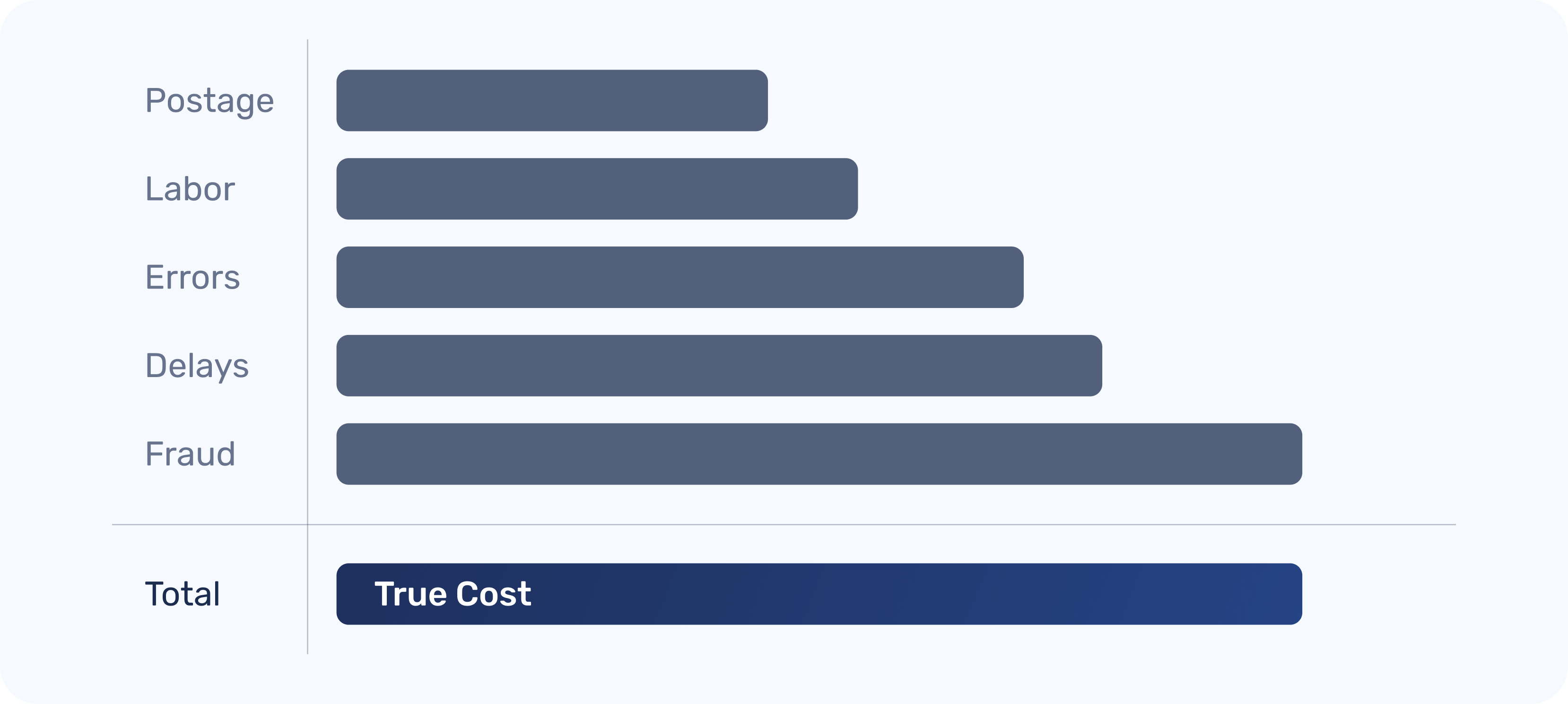
Every manual payment involves human touches: someone pulls the invoice, enters the data, routes it for approval, processes the payment, and files the documentation. In a fully manual process, a single invoice-to-payment cycle typically involves 8-12 distinct steps, each requiring human action. At a loaded cost of $30-50 per hour for AP staff time, the labor per transaction adds up quickly.
The math compounds with error rates. Manual data entry in finance has an error rate somewhere between 1% and 4%, depending on process design and the quality of source documents. Each error requires investigation and correction, typically taking 30-90 minutes of staff time to resolve. At scale, error correction can consume 15-20% of total AP staff hours.
Manual payment processes create reconciliation complexity that consumes significant finance team bandwidth at the end of every period. The core problem is timing: payments are initiated, mailed, cleared, and posted across a span of days or weeks, with each step creating a potential mismatch between what the GL shows and what the bank shows.
A finance team managing 400 vendor payments per month in a manual process typically spends 2-4 days per close just on AP reconciliation, matching cleared checks to open payables, investigating items in transit, and clearing exceptions. At scale, this is a meaningful cost that shows up entirely in labor, which makes it easy to overlook in a process cost analysis that focuses on direct fees.
The defining characteristic of manual payment processes is that they scale linearly: twice the transaction volume means twice the staff time, twice the error rate, twice the reconciliation burden. Automated processes, by contrast, scale sub-linearly; the incremental cost of processing an additional payment is very low once the infrastructure is in place.
This makes the cost gap between manual and automated processes a growth problem, not just an efficiency problem. At 100 transactions per month, the manual process is manageable. At 1,000, it requires significant headcount. At 5,000, it becomes a genuine operational constraint. Companies that are growing quickly and have not automated their payment workflows often find that AP becomes a bottleneck before they expect it to.
The biggest ROI from payment automation typically comes from the highest-volume, most repetitive parts of the process: recurring vendor payments, employee expense reimbursements, and subscription management. These are the categories where the manual process is most predictable and the automation opportunity is clearest.
Virtual cards are one of the most effective starting points because they simultaneously address payment execution, receipt capture, reconciliation, and fraud prevention, all in one structural change. The cost savings are measurable, the implementation is straightforward, and the improvement in finance team capacity shows up within the first close cycle.
Dawn Lewis
Controller at Couranto
Bridget Cobb
Staff Accountant at Healthstream
Brittany Nolan
Sr. Product Marketing Manager at Extend (moderator)

Most finance teams know that manual payment processes are expensive. What they often underestimate is by how much, because the costs are distributed across multiple line items, some of which are invisible in a standard cost accounting framework. The fully loaded cost of a manual AP process is almost always higher than the number finance leaders cite when asked, because the calculation usually stops at the obvious costs.
Here is a more complete picture of what manual payment processes actually cost growing businesses, and where the savings from automation tend to show up.
The direct costs of manual payment processing are the easiest to quantify: check stock and printer supplies, postage, bank fees for wire transfers, and the flat per-transaction fees charged by some payment processors. For a company writing 300 checks a month, these direct costs are real and easy to measure.
But direct costs typically represent 20-30% of the fully loaded cost of a manual payment operation. The rest is in the less visible categories.
Every manual payment involves human touches: someone pulls the invoice, enters the data, routes it for approval, processes the payment, and files the documentation. In a fully manual process, a single invoice-to-payment cycle typically involves 8-12 distinct steps, each requiring human action. At a loaded cost of $30-50 per hour for AP staff time, the labor per transaction adds up quickly.
The math compounds with error rates. Manual data entry in finance has an error rate somewhere between 1% and 4%, depending on process design and the quality of source documents. Each error requires investigation and correction, typically taking 30-90 minutes of staff time to resolve. At scale, error correction can consume 15-20% of total AP staff hours.
Manual payment processes create reconciliation complexity that consumes significant finance team bandwidth at the end of every period. The core problem is timing: payments are initiated, mailed, cleared, and posted across a span of days or weeks, with each step creating a potential mismatch between what the GL shows and what the bank shows.
A finance team managing 400 vendor payments per month in a manual process typically spends 2-4 days per close just on AP reconciliation, matching cleared checks to open payables, investigating items in transit, and clearing exceptions. At scale, this is a meaningful cost that shows up entirely in labor, which makes it easy to overlook in a process cost analysis that focuses on direct fees.
The defining characteristic of manual payment processes is that they scale linearly: twice the transaction volume means twice the staff time, twice the error rate, twice the reconciliation burden. Automated processes, by contrast, scale sub-linearly; the incremental cost of processing an additional payment is very low once the infrastructure is in place.
This makes the cost gap between manual and automated processes a growth problem, not just an efficiency problem. At 100 transactions per month, the manual process is manageable. At 1,000, it requires significant headcount. At 5,000, it becomes a genuine operational constraint. Companies that are growing quickly and have not automated their payment workflows often find that AP becomes a bottleneck before they expect it to.
The biggest ROI from payment automation typically comes from the highest-volume, most repetitive parts of the process: recurring vendor payments, employee expense reimbursements, and subscription management. These are the categories where the manual process is most predictable and the automation opportunity is clearest.
Virtual cards are one of the most effective starting points because they simultaneously address payment execution, receipt capture, reconciliation, and fraud prevention, all in one structural change. The cost savings are measurable, the implementation is straightforward, and the improvement in finance team capacity shows up within the first close cycle.
Most finance teams know that manual payment processes are expensive. What they often underestimate is by how much, because the costs are distributed across multiple line items, some of which are invisible in a standard cost accounting framework. The fully loaded cost of a manual AP process is almost always higher than the number finance leaders cite when asked, because the calculation usually stops at the obvious costs.
Here is a more complete picture of what manual payment processes actually cost growing businesses, and where the savings from automation tend to show up.
The direct costs of manual payment processing are the easiest to quantify: check stock and printer supplies, postage, bank fees for wire transfers, and the flat per-transaction fees charged by some payment processors. For a company writing 300 checks a month, these direct costs are real and easy to measure.
But direct costs typically represent 20-30% of the fully loaded cost of a manual payment operation. The rest is in the less visible categories.
Every manual payment involves human touches: someone pulls the invoice, enters the data, routes it for approval, processes the payment, and files the documentation. In a fully manual process, a single invoice-to-payment cycle typically involves 8-12 distinct steps, each requiring human action. At a loaded cost of $30-50 per hour for AP staff time, the labor per transaction adds up quickly.
The math compounds with error rates. Manual data entry in finance has an error rate somewhere between 1% and 4%, depending on process design and the quality of source documents. Each error requires investigation and correction, typically taking 30-90 minutes of staff time to resolve. At scale, error correction can consume 15-20% of total AP staff hours.
Manual payment processes create reconciliation complexity that consumes significant finance team bandwidth at the end of every period. The core problem is timing: payments are initiated, mailed, cleared, and posted across a span of days or weeks, with each step creating a potential mismatch between what the GL shows and what the bank shows.
A finance team managing 400 vendor payments per month in a manual process typically spends 2-4 days per close just on AP reconciliation, matching cleared checks to open payables, investigating items in transit, and clearing exceptions. At scale, this is a meaningful cost that shows up entirely in labor, which makes it easy to overlook in a process cost analysis that focuses on direct fees.
The defining characteristic of manual payment processes is that they scale linearly: twice the transaction volume means twice the staff time, twice the error rate, twice the reconciliation burden. Automated processes, by contrast, scale sub-linearly; the incremental cost of processing an additional payment is very low once the infrastructure is in place.
This makes the cost gap between manual and automated processes a growth problem, not just an efficiency problem. At 100 transactions per month, the manual process is manageable. At 1,000, it requires significant headcount. At 5,000, it becomes a genuine operational constraint. Companies that are growing quickly and have not automated their payment workflows often find that AP becomes a bottleneck before they expect it to.
The biggest ROI from payment automation typically comes from the highest-volume, most repetitive parts of the process: recurring vendor payments, employee expense reimbursements, and subscription management. These are the categories where the manual process is most predictable and the automation opportunity is clearest.
Virtual cards are one of the most effective starting points because they simultaneously address payment execution, receipt capture, reconciliation, and fraud prevention, all in one structural change. The cost savings are measurable, the implementation is straightforward, and the improvement in finance team capacity shows up within the first close cycle.

Most finance teams know that manual payment processes are expensive. What they often underestimate is by how much, because the costs are distributed across multiple line items, some of which are invisible in a standard cost accounting framework. The fully loaded cost of a manual AP process is almost always higher than the number finance leaders cite when asked, because the calculation usually stops at the obvious costs.
Here is a more complete picture of what manual payment processes actually cost growing businesses, and where the savings from automation tend to show up.
The direct costs of manual payment processing are the easiest to quantify: check stock and printer supplies, postage, bank fees for wire transfers, and the flat per-transaction fees charged by some payment processors. For a company writing 300 checks a month, these direct costs are real and easy to measure.
But direct costs typically represent 20-30% of the fully loaded cost of a manual payment operation. The rest is in the less visible categories.
Every manual payment involves human touches: someone pulls the invoice, enters the data, routes it for approval, processes the payment, and files the documentation. In a fully manual process, a single invoice-to-payment cycle typically involves 8-12 distinct steps, each requiring human action. At a loaded cost of $30-50 per hour for AP staff time, the labor per transaction adds up quickly.
The math compounds with error rates. Manual data entry in finance has an error rate somewhere between 1% and 4%, depending on process design and the quality of source documents. Each error requires investigation and correction, typically taking 30-90 minutes of staff time to resolve. At scale, error correction can consume 15-20% of total AP staff hours.
Manual payment processes create reconciliation complexity that consumes significant finance team bandwidth at the end of every period. The core problem is timing: payments are initiated, mailed, cleared, and posted across a span of days or weeks, with each step creating a potential mismatch between what the GL shows and what the bank shows.
A finance team managing 400 vendor payments per month in a manual process typically spends 2-4 days per close just on AP reconciliation, matching cleared checks to open payables, investigating items in transit, and clearing exceptions. At scale, this is a meaningful cost that shows up entirely in labor, which makes it easy to overlook in a process cost analysis that focuses on direct fees.
The defining characteristic of manual payment processes is that they scale linearly: twice the transaction volume means twice the staff time, twice the error rate, twice the reconciliation burden. Automated processes, by contrast, scale sub-linearly; the incremental cost of processing an additional payment is very low once the infrastructure is in place.
This makes the cost gap between manual and automated processes a growth problem, not just an efficiency problem. At 100 transactions per month, the manual process is manageable. At 1,000, it requires significant headcount. At 5,000, it becomes a genuine operational constraint. Companies that are growing quickly and have not automated their payment workflows often find that AP becomes a bottleneck before they expect it to.
The biggest ROI from payment automation typically comes from the highest-volume, most repetitive parts of the process: recurring vendor payments, employee expense reimbursements, and subscription management. These are the categories where the manual process is most predictable and the automation opportunity is clearest.
Virtual cards are one of the most effective starting points because they simultaneously address payment execution, receipt capture, reconciliation, and fraud prevention, all in one structural change. The cost savings are measurable, the implementation is straightforward, and the improvement in finance team capacity shows up within the first close cycle.
Learn more about Extend and find out if it's the right solution for your business.


%201.png)


%201.png)
